

What Are the Delivery Options for Bulk Refrigerant?
When purchasing refrigerant in commercial quantities, choosing the right delivery method is just as important as selecting the right product. Bulk refrigerant delivery involves additional logistics and compliance considerations because many refrigerants are pressurized products and may be regulated as dangerous goods or subject to environmental and import controls.
So, what are the delivery options for bulk refrigerant?
The main options can include sea freight, full-container-load (FCL) shipping, less-than-container-load (LCL) shipping, road freight, air freight, and multimodal transportation. The appropriate method depends on the refrigerant type, quantity, cylinder specification, destination country, carrier requirements, applicable regulations, and delivery timeframe.
For international B2B buyers, J.E Trading AB supports commercial sourcing and logistics discussions for eligible refrigerant products, subject to availability and applicable laws.
This guide explains the main delivery options, their advantages, important considerations, and how businesses can plan an efficient bulk refrigerant shipment.
What Is Bulk Refrigerant Delivery?
Bulk refrigerant delivery refers to the transportation of refrigerants in commercial quantities rather than small individual purchases.
Depending on the buyer’s requirements, an order can involve:
- Multiple refrigerant cylinders
- Palletized refrigerant cylinders
- Commercial freight shipments
- Containerized shipments
- Regional truck deliveries
- Specialized industrial transportation
The exact shipping format depends on the refrigerant.
For example, R32, R290, R600a, R134a, R404A, R410A, R1234yf, R744, and R717 have different characteristics and may therefore have different transportation and regulatory requirements.
A professional buyer should identify the exact refrigerant designation before requesting a shipping quotation.
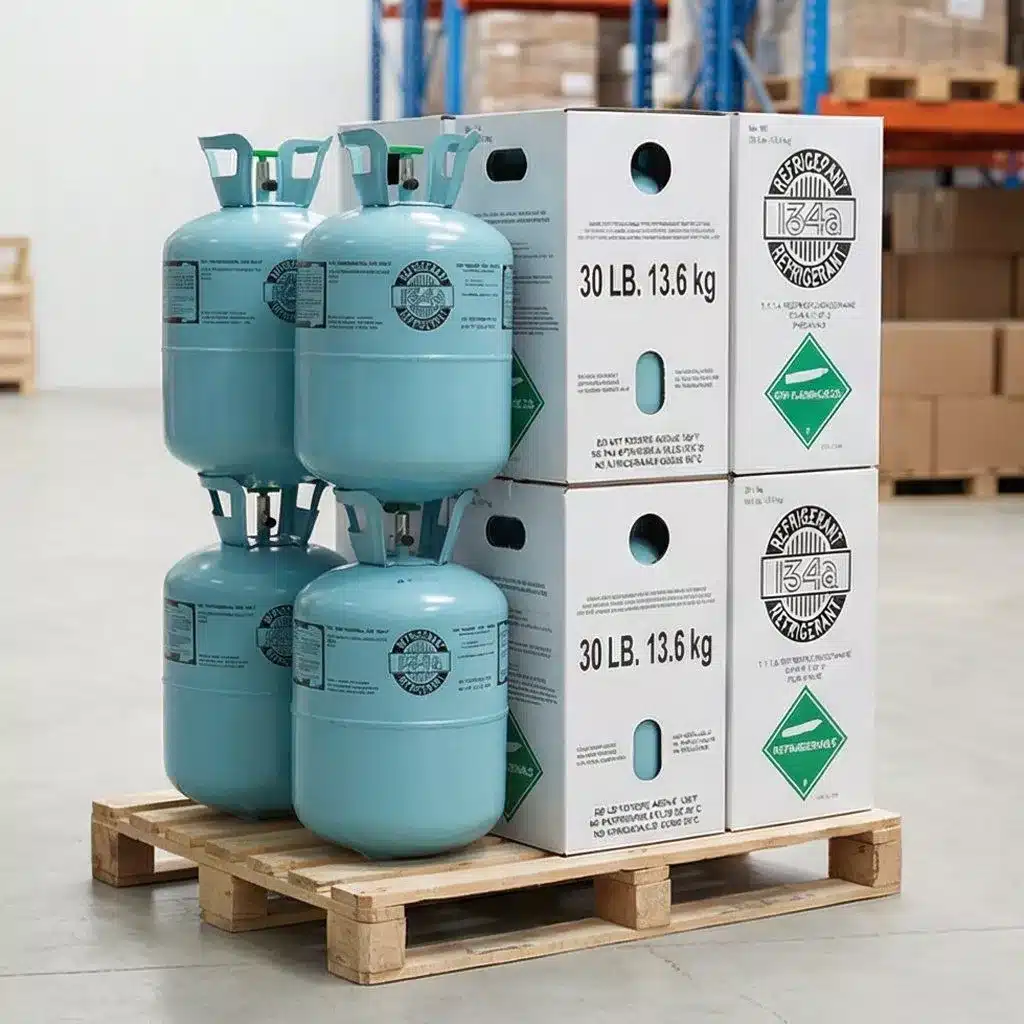
The Main Delivery Options for Bulk Refrigerant
The most common delivery options include:
- Sea freight
- Full Container Load (FCL)
- Less-than-Container Load (LCL)
- Road freight
- Air freight
- Multimodal transportation
- Regional warehouse or distributor delivery
Not every option is suitable for every refrigerant.
Transportation acceptance must be confirmed with the relevant carrier or freight forwarder before shipment.
1. Sea Freight for Bulk Refrigerant
For larger international orders, sea freight can be an important option.
Sea transportation is particularly relevant for wholesale buyers importing commercial quantities over long distances.
Potential users include:
- HVAC distributors
- Refrigeration wholesalers
- Industrial buyers
- National distributors
- Commercial refrigeration suppliers
- Equipment companies
- International trading companies
Advantages of Sea Freight
Sea freight can provide:
- Cost efficiency for larger shipments
- High cargo capacity
- International port coverage
- Suitable solutions for planned inventory purchases
- Integration with container logistics
Important Considerations
Refrigerants may be regulated cargo, so sea shipments must comply with applicable maritime dangerous-goods requirements.
Depending on the product, requirements can concern:
- Cylinder specifications
- Cargo classification
- Labeling
- Documentation
- Container requirements
- Carrier acceptance
- Customs
- Import regulations
Therefore, buyers should confirm the exact shipping requirements before booking.
2. Full Container Load (FCL)
Full Container Load, commonly called FCL, can be considered when the buyer has a sufficiently large commercial order.
Instead of sharing container capacity with other cargo, the buyer’s shipment occupies a dedicated container.
FCL can be attractive for:
- Large distributors
- National wholesalers
- Industrial buyers
- Regional distribution programs
- High-volume importers
Benefits of FCL
Potential advantages include:
- Dedicated container space
- Efficient handling of large shipments
- Greater control over cargo organization
- Reduced consolidation requirements
- Predictable container planning
However, a standard container cannot automatically be treated as suitable for every refrigerant.
The carrier and logistics provider must confirm that the proposed refrigerant, packaging, quantity, and container arrangement meet applicable transportation rules.
3. Less-than-Container Load (LCL)
LCL shipping can be considered when a buyer’s order does not require a full container.
Under LCL, cargo is consolidated with other shipments.
Potential advantages include:
- Access to international sea freight without filling an entire container
- Flexibility for smaller commercial orders
- Potentially lower total freight expenditure for certain shipment sizes
However, refrigerants may have dangerous-goods requirements that can affect whether an LCL service is available.
Additional considerations can include:
- Consolidation restrictions
- Handling requirements
- Documentation
- Carrier acceptance
- Port procedures
- Additional handling charges
For this reason, buyers should ask a qualified freight forwarder whether LCL is available for the exact refrigerant.
4. Road Freight for Bulk Refrigerant
Road transportation is particularly useful for domestic and regional deliveries.
It can be used for:
- Warehouse replenishment
- Distributor deliveries
- Domestic wholesale orders
- Regional distribution
- Cross-border commercial shipments
Road freight can provide more direct delivery than sea transportation.
For example, a regional shipment may move from:
Supplier warehouse → Distribution center → Buyer warehouse
However, road transportation can be subject to dangerous-goods requirements depending on the refrigerant.
Requirements may involve:
- Approved packaging
- Vehicle requirements
- Transport documentation
- Driver qualifications
- Cargo labeling
- Quantity restrictions
- Route requirements
The exact requirements depend on the product and jurisdiction.
5. Air Freight for Bulk Refrigerant
Air freight offers potentially faster transportation, but it is also more restrictive for many pressurized or regulated products.
Not every refrigerant can be transported by air under the same conditions.
Before considering air freight, buyers should confirm:
- Refrigerant classification
- Airline acceptance
- Packaging requirements
- Quantity limitations
- Dangerous-goods documentation
- Destination-country regulations
- Airport handling requirements
When Can Air Freight Make Sense?
Where legally permitted and accepted by the carrier, air freight may be considered for:
- Urgent commercial requirements
- Time-sensitive replacement stock
- Smaller shipments
- High-priority deliveries
However, air freight is generally more expensive than sea freight for large commercial volumes.
6. Multimodal Refrigerant Transportation
International refrigerant shipments can use multiple transportation modes.
For example:
Truck → Port → Ocean Freight → Truck → Buyer Warehouse
This is a typical multimodal logistics structure.
Other combinations can include:
- Road + sea
- Road + air
- Rail + road
- Road + sea + road
Multimodal transportation can help connect international suppliers with inland buyers.
The important consideration is that each stage must comply with the requirements applicable to the refrigerant.
7. Regional Warehouse Delivery
For some commercial markets, buyers may obtain refrigerant through a regional warehouse or distribution facility.
This can provide advantages such as:
- Faster local delivery
- Reduced international transportation complexity
- Easier inventory replenishment
- Regional stock availability
- Potentially shorter lead times
However, availability depends on the supplier’s inventory structure and the regulatory requirements of the market.
Bulk Refrigerant Delivery Options by Order Size
The following table provides a general commercial overview:
| Order Type | Potential Delivery Method | Typical Consideration |
|---|---|---|
| Small commercial order | Road / approved freight | Product and carrier restrictions |
| Multiple cylinders | Palletized freight | Packaging and handling |
| Regional wholesale order | Road freight | Dangerous-goods requirements may apply |
| Medium international order | LCL / specialized freight | Carrier acceptance |
| Large international order | FCL / sea freight | Container and regulatory planning |
| Urgent eligible shipment | Air freight | Strict carrier restrictions |
| Large industrial requirement | Specialized logistics | Product-specific requirements |
This is a general guide rather than a guarantee that a particular transportation method is available for every refrigerant.
How Does Refrigerant Packaging Affect Delivery?
Packaging is a major part of refrigerant logistics.
Refrigerants are commonly supplied in cylinders designed for the specific product.
Commercial packaging may differ according to:
- Refrigerant
- Cylinder capacity
- Net fill
- Valve configuration
- Country
- Manufacturer
- Transportation method
- Applicable regulations
The packaging must be appropriate for the product and transportation method.
Buyers should request confirmed packaging information before calculating container capacity or freight costs.
Palletized Bulk Refrigerant Shipments
For wholesale orders, cylinders may be arranged on pallets where permitted.
Palletization can improve:
- Warehouse handling
- Cargo organization
- Loading efficiency
- Inventory management
- Distribution
However, pallet configuration depends on:
- Cylinder dimensions
- Cylinder weight
- Number of cylinders
- Pallet dimensions
- Stacking restrictions
- Carrier requirements
Therefore, buyers should obtain the confirmed pallet configuration from the supplier or freight provider.
What Documents Are Required for Bulk Refrigerant Delivery?
Documentation varies according to the refrigerant, origin, destination, and transportation method.
Potential documents can include:
- Commercial invoice
- Packing list
- Bill of lading
- Certificate of origin
- Safety Data Sheet
- Product specification
- Certificate of Analysis, where applicable
- Dangerous-goods documentation
- Import permits
- Environmental documentation
- Customs documentation
Not every shipment requires every document.
The required documentation should be confirmed before dispatch.
Dangerous-Goods Transportation
One of the most important aspects of refrigerant logistics is dangerous-goods compliance.
Some refrigerants are classified as dangerous goods because of their physical or chemical characteristics.
Depending on the exact product, transportation considerations can include:
- UN identification
- Proper shipping name
- Hazard classification
- Packaging
- Labeling
- Documentation
- Carrier acceptance
- Quantity limitations
The classification should be determined from the product’s official transportation documentation.
Buyers should work with freight forwarders that have experience transporting regulated refrigerants.
Why the Refrigerant Type Matters
Different refrigerants have different transport characteristics.
For example:
R32
R32 is a refrigerant used in air-conditioning and heat-pump applications and has flammability considerations.
R134a
R134a is an HFC refrigerant used historically across several refrigeration and cooling applications.
R404A
R404A is a high-GWP refrigerant blend historically associated with commercial and industrial refrigeration.
R410A
R410A is an HFC blend historically used extensively in air-conditioning systems.
R1234yf
R1234yf is a lower-GWP HFO refrigerant commonly associated with automotive air conditioning.
R290
R290 is refrigerant-grade propane and is highly flammable.
R600a
R600a is refrigerant-grade isobutane and is also flammable.
R744
R744 is carbon dioxide used in various commercial and industrial refrigeration applications.
R717
R717 is ammonia and requires specialized industrial systems and safety controls.
Because of these differences, there is no universal shipping method for “refrigerant gas.”
International Refrigerant Delivery
For international shipments, buyers should evaluate the complete logistics chain.
This includes:
Supplier → Export procedures → Main transportation → Import customs → Destination handling → Final delivery
Each stage can introduce requirements or costs.
A professional buyer should establish the responsibilities of the supplier, buyer, freight forwarder, and customs broker before shipment.
Refrigerant Import Regulations
Before purchasing bulk refrigerant internationally, the buyer should confirm whether the selected product can legally be imported into the destination country.
Depending on the market, controls may include:
- Environmental regulations
- Import permits
- Licensing
- Quotas
- F-gas requirements
- Ozone-depleting-substance controls
- Product registration
- Customs requirements
- Labeling requirements
These requirements can change over time.
Therefore, current regulations should be verified before each international transaction.
European Bulk Refrigerant Delivery
The European market has increasingly stringent controls concerning fluorinated greenhouse gases and other regulated refrigerants.
Depending on the product and application, European buyers may need to consider:
- F-gas requirements
- Import controls
- Quotas
- Certification
- Equipment restrictions
- Documentation
- Recordkeeping
- Recovery requirements
The regulatory status of a refrigerant should be checked against current EU and national requirements.
Bulk Refrigerant Delivery to the Middle East
The Middle East has substantial demand for HVAC and cooling products.
Commercial refrigerant applications can include:
- Building air conditioning
- Commercial refrigeration
- Industrial cooling
- Cold storage
- HVAC maintenance
- Heat pumps
However, individual countries can have different import requirements.
Buyers should verify destination-specific rules before ordering.
Bulk Refrigerant Delivery to Africa
Refrigerants are used across African markets for:
- Commercial refrigeration
- Food storage
- Supermarkets
- Hospitality
- HVAC systems
- Industrial refrigeration
- Cold-chain infrastructure
Importers should check local environmental, customs, transportation, and product requirements.
Bulk Refrigerant Delivery to Asia
Asia represents a major global HVAC and refrigeration market.
Wholesale demand can involve:
- Air-conditioning refrigerants
- Commercial refrigeration gases
- Industrial refrigerants
- Heat-pump refrigerants
- Automotive refrigerants
However, individual countries have different regulations.
Destination-specific compliance should therefore be confirmed before shipment.
Bulk Refrigerant Delivery to North America
North American refrigerant regulations are evolving as markets transition toward lower-GWP technologies.
Requirements can vary depending on:
- Refrigerant type
- Equipment
- Intended use
- New installation
- Existing equipment
- Servicing
- Import
- Export
- Federal requirements
- State or regional requirements
Importers should verify current rules before arranging delivery.
Sea Freight vs Air Freight for Bulk Refrigerant
| Factor | Sea Freight | Air Freight |
|---|---|---|
| Large commercial quantities | Generally more suitable | More restrictive |
| Transit time | Longer | Faster |
| Freight cost | Usually lower for large volumes | Usually higher |
| Cargo capacity | High | Lower |
| Dangerous goods | Subject to maritime requirements | Strict air-transport requirements |
| Urgent shipments | Less suitable | Potentially suitable where permitted |
| Carrier acceptance | Product dependent | Product dependent |
For most planned wholesale purchases, sea freight may be commercially attractive, while air freight can be considered only where the exact product is accepted and transportation is legally permitted.
How to Choose the Right Delivery Option
A buyer should consider five major factors.
1. Product Type
The refrigerant determines many transportation requirements.
2. Quantity
Larger quantities can favor palletized or containerized transportation.
3. Destination
The destination determines import and regulatory requirements.
4. Delivery Time
Urgent orders may require faster transportation if available.
5. Total Landed Cost
The lowest freight rate does not necessarily produce the lowest overall cost.
Buyers should calculate:
Product + Freight + Insurance + Customs + Duties + Taxes + Port Charges + Local Delivery
How to Reduce Bulk Refrigerant Delivery Costs
Professional buyers can improve logistics efficiency through planning.
Consolidate Orders
Larger planned orders can potentially reduce transportation costs per unit.
Optimize Pallets
Efficient pallet configuration can improve cargo utilization.
Plan Shipments Early
Advance planning can provide more transportation options.
Select Appropriate Incoterms
Choose an Incoterm that clearly defines transportation and customs responsibilities.
Use Specialist Freight Forwarders
Choose logistics providers familiar with regulated refrigerant transportation.
Prepare Documentation Early
Documentation problems can cause delays and additional costs.
Incoterms for Refrigerant Delivery
Commercial transactions may use Incoterms such as:
- EXW
- FCA
- FOB
- CFR
- CIF
- DAP
- DDP where appropriate
The chosen Incoterm determines responsibilities for transportation, customs, insurance, and delivery.
For regulated refrigerants, buyers should ensure that the responsibilities for regulatory compliance are clearly understood.
Refrigerant Delivery Lead Time
Total delivery time can consist of:
- Product confirmation
- Stock verification
- Regulatory review
- Documentation
- Packaging
- Freight booking
- Export clearance
- Main transportation
- Import clearance
- Final delivery
Therefore, shipping transit time is not necessarily the same as total order lead time.
Buyers should request both the estimated preparation period and transportation time.
Bulk Refrigerant Delivery Specification Form
| Specification | Buyer Requirement |
|---|---|
| Product | Refrigerant Gas |
| Refrigerant | Exact R-designation |
| Chemical Family | HFC / HFO / HCFC / Natural / Blend |
| Quantity | Required net weight |
| Cylinders | Number of cylinders |
| Cylinder Size | Required format |
| Packaging | Approved commercial packaging |
| Origin | Required origin |
| Destination Country | Buyer specification |
| Destination Port | Buyer specification |
| Final Delivery | Warehouse / facility |
| Transport Mode | Sea / Road / Air where permitted |
| Incoterm | EXW / FCA / FOB / CIF / DAP etc. |
| Documentation | Buyer requirements |
| Import Permit | Buyer to confirm |
| Regulatory Approval | Destination-specific |
| Required Delivery Date | Buyer requirement |
Common Bulk Refrigerant Delivery Mistakes
Mistake 1: Treating Refrigerant as Ordinary Cargo
Refrigerants may have dangerous-goods and environmental requirements.
Mistake 2: Choosing Freight Before Identifying the Product
The exact refrigerant should be established before selecting transportation.
Mistake 3: Ignoring Import Restrictions
A refrigerant may be commercially available but restricted in the destination country.
Mistake 4: Using Incorrect Cylinder Information
Cylinder specifications should be confirmed before freight planning.
Mistake 5: Focusing Only on Freight Price
Total landed cost is more important than the freight quote alone.
Mistake 6: Leaving Documentation Until the Last Minute
International shipments can require multiple commercial and regulatory documents.
How to Request a Bulk Refrigerant Delivery Quote
To obtain an accurate quotation from J.E Trading AB, buyers should provide:
Refrigerant: Exact designation
Quantity: Total required volume
Cylinder: Required cylinder size
Destination: Country and city/port
Application: Intended legitimate commercial application
Shipping: Preferred transportation mode
Incoterm: Preferred delivery term
Documentation: Required documents
Delivery: Desired timeframe
Providing complete information allows the supplier and logistics provider to assess the appropriate transportation method.
Frequently Asked Questions
What are the delivery options for bulk refrigerant?
The principal options include sea freight, FCL, LCL, road freight, air freight where permitted, and multimodal transportation.
What is the best shipping method for bulk refrigerant?
For larger international orders, sea freight can often be commercially attractive. Road freight may be suitable for regional deliveries, while air freight may be considered for eligible urgent shipments.
Can bulk refrigerant be shipped by sea?
Many refrigerants can be transported by sea subject to applicable dangerous-goods, packaging, carrier, customs, and environmental requirements.
Can refrigerant be shipped by air?
Some refrigerants may be transported by air when permitted, but air freight has strict dangerous-goods requirements and carrier restrictions.
Is LCL available for refrigerant?
LCL availability depends on the specific refrigerant, packaging, classification, freight forwarder, and carrier.
Can refrigerant be shipped by road?
Yes, where permitted. Road transportation can be useful for domestic and regional distribution but may be subject to dangerous-goods regulations.
Do refrigerants require special packaging?
Yes. Packaging requirements depend on the refrigerant, cylinder type, transportation method, and applicable regulations.
What information is needed for a shipping quote?
The most important information includes the exact refrigerant, quantity, cylinder size, destination country, destination port, preferred transportation mode, and required documentation.
Are all refrigerants available for international delivery?
No. Availability and legal transport depend on the refrigerant, origin, destination, current regulations, and carrier requirements.
How can I reduce bulk refrigerant shipping costs?
Planning larger consolidated orders, optimizing palletization, comparing qualified freight providers, selecting appropriate Incoterms, and preparing documents early can help improve logistics efficiency.
Conclusion: Choosing the Right Bulk Refrigerant Delivery Option
So, what are the delivery options for bulk refrigerant?
International buyers can potentially choose from sea freight, FCL, LCL, road transportation, air freight where permitted, multimodal transportation, and regional distribution.
The right choice depends on several factors:
- Refrigerant type
- Quantity
- Cylinder specification
- Destination
- Regulatory status
- Transportation classification
- Delivery timeframe
- Import requirements
- Total landed cost
For large planned wholesale orders, sea freight and containerized logistics can often provide practical commercial solutions. Road freight can be effective for regional distribution, while air freight may be considered for eligible time-sensitive shipments.
The most important principle is that refrigerant transportation should be planned around the exact product and applicable regulations, rather than assuming that every refrigerant can be transported in the same way.
J.E Trading AB supports professional international buyers seeking wholesale refrigerant gas and commercial delivery solutions, subject to product availability, carrier acceptance, destination-market requirements, and applicable laws.
Request a Wholesale Refrigerant Delivery Quote
When contacting J.E Trading AB, provide the exact refrigerant designation, required quantity, cylinder size, destination country and port, preferred delivery method, Incoterm, and documentation requirements.
This information allows the commercial and logistics requirements to be evaluated before shipment.
J.E Trading AB – International Wholesale Trading and Global Product Sourcing.