

How to Import Refrigerant Gas: A Complete Guide for International Buyers
Importing refrigerant gas is a specialized B2B procurement activity that requires careful attention to product specifications, international trade regulations, environmental rules, documentation, packaging requirements, customs procedures, and destination-market compliance.
For HVAC distributors, refrigeration companies, industrial buyers, importers, wholesalers, and commercial suppliers, sourcing refrigerant gas internationally can provide access to competitive supply and a wider range of products. However, refrigerants are regulated products, and the requirements for importing them can differ significantly depending on the refrigerant type, country of origin, destination country, intended application, and applicable environmental legislation.
Products such as R32, R134a, R404A, R407C, R410A, R507, R1234yf, R1234ze(E), R290, R600a, R717, and R744 do not necessarily have the same regulatory status or market availability.
This guide explains the major considerations international buyers should understand before purchasing or importing refrigerant gas in bulk.
J.E Trading AB works with international B2B buyers seeking wholesale and bulk refrigerant supply, with product availability, documentation, logistics, and market eligibility assessed according to the specific product and destination.
What Does Importing Refrigerant Gas Involve?
At a commercial level, importing refrigerant gas means purchasing a specified refrigerant from an overseas supplier and arranging its legal entry into the destination market.
The process can involve several parties:
- Manufacturer or exporter
- International trading company
- Importer
- Customs broker
- Freight provider
- Port or terminal
- Regulatory authorities
- Environmental authorities
- Local distributor
- Final commercial customer
The precise responsibilities of each party depend on the transaction structure and destination-country regulations.
Unlike ordinary general merchandise, refrigerants can be subject to environmental and transportation controls. Therefore, buyers should establish regulatory eligibility before committing to a commercial shipment.
Why Refrigerant Imports Are Regulated
Many refrigerants have environmental characteristics that have led governments to introduce controls on their production, importation, exportation, sale, use, or phase-down.
The international framework includes the Montreal Protocol and its Kigali Amendment, while individual countries and regional blocs establish their own implementing legislation.
For example, in the United States, the EPA’s HFC program controls the production and consumption of bulk regulated HFCs through an allowance system. EPA states that bulk HFC imports require the appropriate allowances, subject to applicable exceptions.
The European Union and other jurisdictions likewise have their own fluorinated-gas and import-control frameworks.
Consequently, international buyers should never assume that a refrigerant available for sale in one country can automatically be imported into another.
Step 1: Identify the Exact Refrigerant
The first step in any professional refrigerant procurement process is identifying the exact product.
A request such as:
“We need refrigerant gas.”
is generally insufficient for an international quotation.
A buyer should identify the specific refrigerant designation.
Examples include:
- R32
- R134a
- R404A
- R407C
- R410A
- R507
- R1234yf
- R1234ze(E)
- R290
- R600a
- R717
- R744
Different refrigerants have different technical characteristics and regulatory classifications.
Step 2: Confirm the Intended Market and Application
The destination market is one of the most important factors in determining whether a refrigerant can be commercially imported.
The buyer should establish:
- Destination country
- Intended commercial application
- Existing-equipment requirements
- New-equipment requirements
- Applicable environmental rules
- Import restrictions
- Distributor requirements
- Applicable product standards
For example, a refrigerant intended for an existing HVAC system may have a different commercial context from a refrigerant intended for newly manufactured equipment.
Step 3: Check Destination-Country Regulations
Before placing a bulk order, buyers should determine whether the selected refrigerant is permitted for import into the destination market.
Regulations can address:
- Import licensing
- Quotas or allowances
- Product registration
- Environmental reporting
- Customs requirements
- Labeling
- Packaging
- Recordkeeping
- Sale and distribution
- Intended applications
In the United States, for example, EPA’s current HFC framework includes allowance requirements for bulk HFC imports and separate restrictions affecting products and equipment containing HFCs.
This illustrates why a generic statement such as “refrigerant gas is legal to import” is not sufficient.
The answer depends on which refrigerant, what quantity, what form, what application, and which country.
Step 4: Determine Whether the Product Is Bulk Refrigerant
The distinction between bulk refrigerant and refrigerant contained within equipment can be important.
For example, the U.S. EPA defines bulk HFCs as regulated substances contained in containers such as cylinders, drums, and ISO tanks for transportation or storage, where the substance is subsequently transferred for use.
Therefore, importers should clearly establish whether their transaction concerns:
- Bulk refrigerant
- Refrigerant contained in equipment
- Refrigerant contained in components
- Refrigerant-containing products
Different regulatory frameworks can apply.
Step 5: Select a Qualified International Supplier
Supplier selection is a critical part of international refrigerant procurement.
A professional wholesale supplier should be able to provide clear information regarding:
Product
- Exact refrigerant
- Product specification
- Purity specification
- Origin
- Available packaging
- Commercial quantity
Documentation
- Safety Data Sheet (SDS)
- Certificate of Analysis (COA), where applicable
- Certificate of Origin
- Commercial invoice
- Packing list
- Other applicable documentation
Commercial terms
- MOQ
- Price
- Lead time
- Payment terms
- Incoterms
- Delivery options
Compliance
The supplier should be able to identify the relevant product information needed by the buyer and logistics partners without making unsupported claims about regulatory eligibility.
Step 6: Verify Product Quality
Quality verification is particularly important when purchasing refrigerant gas internationally.
Buyers should establish the agreed specification before purchasing.
Depending on the product and transaction, documentation may include:
| Document | Purpose |
|---|---|
| Certificate of Analysis | Supports verification of agreed product characteristics |
| Safety Data Sheet | Provides safety and regulatory information |
| Certificate of Origin | Identifies declared country of origin |
| Commercial Invoice | Establishes commercial transaction details |
| Packing List | Identifies shipment and packaging information |
| Product Specification | Defines agreed product characteristics |
| Transport Documentation | Supports applicable logistics requirements |
Not every shipment requires every document listed above, and exact requirements vary by destination and product.
Step 7: Verify Packaging Requirements
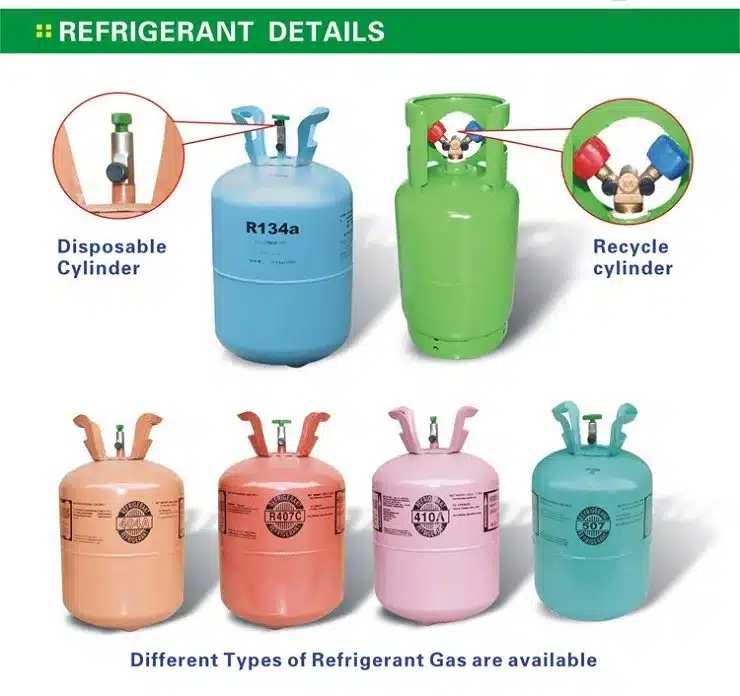
Refrigerants may be supplied in specialized containers or cylinders appropriate to the product and applicable transport requirements.
The buyer should confirm:
- Cylinder type
- Cylinder capacity
- Net quantity
- Gross quantity
- Number of cylinders
- Packaging configuration
- Labeling
- Pallet configuration where applicable
Packaging specifications should be agreed before the purchase order is finalized.
The supplier, carrier, and relevant authorities may also have additional requirements depending on the specific refrigerant.
Step 8: Confirm Customs Classification
Correct customs classification is an important part of international trade.
The importer and its customs broker should verify the appropriate tariff classification and associated regulatory requirements for the exact product.
A professional import file should contain consistent information across:
- Commercial invoice
- Packing list
- Customs declaration
- Product description
- Product documentation
- Transport documentation
Incorrect or incomplete descriptions can create customs delays or compliance issues.
For example, simply describing cargo as “gas” may be insufficient where authorities require a more precise identification of the substance.
Step 9: Understand Import Licensing and Allowances
Some refrigerants can be subject to specific import licensing, quota, allowance, or environmental controls.
This is particularly important for HFC refrigerants.
In the United States, EPA explains that importing bulk regulated HFCs requires the appropriate consumption allowances, with the importer of record responsible for the applicable import requirements. EPA also specifies advance notification and reporting requirements for regulated bulk HFC imports.
Other countries use different systems.
Therefore, buyers should determine:
- Whether the refrigerant is regulated
- Whether an import license applies
- Whether quotas or allowances apply
- Who is responsible for compliance
- Whether the importer must register
- Whether reporting is required
- Whether restrictions apply to the intended use
Step 10: Evaluate Environmental Requirements
Environmental regulations are increasingly important in refrigerant procurement.
Buyers should consider:
- Global Warming Potential (GWP)
- Ozone Depletion Potential (ODP)
- HFC phase-down requirements
- Fluorinated-gas regulations
- HCFC phase-out requirements
- Local environmental rules
- Future product restrictions
This is particularly important for businesses planning long-term inventory.
A product that is commercially available today may have different market conditions in the future because of regulatory changes.
Major Refrigerant Categories for Importers
International buyers may encounter several major refrigerant categories.
| Category | Examples | General Commercial Consideration |
|---|---|---|
| HFC | R32, R134a, R404A, R407C, R410A | Important legacy and current markets, with regulatory phase-down affecting some products |
| HFO | R1234yf, R1234ze(E) | Increasing importance in lower-GWP applications |
| HCFC | R22 | Highly restricted or phased down in many markets |
| Hydrocarbon | R290, R600a | Low-GWP alternatives with additional safety and regulatory considerations |
| Natural/Inorganic | R717, R744 | Used in specific commercial and industrial applications |
| Blends | R404A, R407C, R507 and others | Formulated refrigerant mixtures used in designated equipment |
The availability and legality of each refrigerant must be evaluated for the destination market.
Importing R32 Refrigerant
R32 is an HFC refrigerant widely associated with newer air-conditioning and heat-pump equipment.
International buyers considering R32 should evaluate:
- Destination-market eligibility
- Equipment compatibility
- Product specification
- Packaging
- Documentation
- Applicable environmental requirements
- Transportation requirements
R32 should not be treated as a universal substitute for every other refrigerant.
Importing R134a Refrigerant
R134a has historically been widely used in automotive air conditioning and various refrigeration applications.
However, regulatory conditions differ by country and application.
Importers should confirm the current status of R134a before purchasing significant inventory.
Importing R404A Refrigerant
R404A has historically been important in commercial refrigeration and low-temperature applications.
However, its relatively high GWP means that regulatory restrictions have become increasingly important in many markets.
An importer should confirm whether R404A can legally enter the destination market and whether the intended application is permitted.
Importing R407C Refrigerant
R407C is a blended HFC refrigerant associated with various HVAC applications.
For international purchasing, buyers should specify:
- R407C
- Required quantity
- Packaging
- Destination
- Documentation
- Intended application
Regulatory requirements should be checked before importation.
Importing R410A Refrigerant
R410A has historically been widely used in air-conditioning and heat-pump systems.
As markets transition toward lower-GWP technologies, its regulatory and commercial status is changing in some jurisdictions.
Importers should therefore consider both:
Current demand
and
long-term inventory risk.
Importing R1234yf
R1234yf is an HFO refrigerant particularly associated with automotive air-conditioning applications.
It has a much lower GWP than many traditional HFC refrigerants.
For international buyers, important considerations include:
- Product authenticity
- Purity/specification
- Packaging
- Automotive-market requirements
- Destination regulations
- Documentation
- Logistics
Importing Natural Refrigerants
Natural refrigerants include products such as:
- R290
- R600a
- R717
- R744
These products can have favorable environmental characteristics but are subject to their own equipment, safety, transportation, and regulatory requirements.
The commercial buyer should therefore evaluate the entire compliance profile rather than choosing a refrigerant solely because of its GWP.
Refrigerant Gas Import Documentation
A professional international transaction may require a documentation package such as:
Commercial Invoice
Shows:
- Seller
- Buyer
- Product
- Quantity
- Price
- Currency
- Incoterm
Packing List
May identify:
- Number of packages
- Cylinder information
- Gross weight
- Net weight
- Packaging details
Certificate of Origin
May identify the declared origin of the product.
Safety Data Sheet
Provides relevant safety and regulatory information.
Certificate of Analysis
May provide batch-specific analytical information where applicable.
Regulatory Documentation
Depending on the destination, additional permits, registrations, declarations, allowances, or environmental documentation may apply.
Refrigerant Import Logistics
Refrigerant shipments require logistics planning appropriate to the product and applicable transportation rules.
Potential commercial logistics options can include:
- Sea freight
- Road freight
- Air freight where permitted
- Multimodal transportation
The appropriate option depends on:
- Product
- Quantity
- Packaging
- Destination
- Carrier requirements
- Regulatory classification
- Delivery schedule
International buyers should work with qualified logistics and customs professionals for shipment-specific requirements.
FOB vs CIF for Refrigerant Imports
Importers may encounter several Incoterms when requesting international quotations.
Common terms include:
- EXW
- FCA
- FOB
- CFR
- CIF
- DAP
- DDP where appropriate
FOB
The buyer generally takes responsibility for the main international freight after the agreed delivery point.
CIF
The seller arranges freight and insurance to the named destination port under the applicable Incoterm rules.
The precise responsibilities should always be confirmed against the current Incoterms® rules and the quotation.
For regulated products, buyers should also confirm which party is responsible for compliance documentation and import formalities.
How Much Does It Cost to Import Refrigerant Gas?
The final cost depends on much more than the supplier’s quoted price.
A buyer may need to consider:
Product cost + packaging + freight + insurance where applicable + customs duties + taxes + destination charges + compliance costs
Factors affecting the commercial price include:
- Refrigerant type
- Quantity
- Packaging
- Origin
- Market availability
- Regulatory status
- Freight costs
- Destination
- Currency
- Import taxes
- Customs duties
For this reason, international buyers should compare total landed cost, rather than comparing only the supplier’s price per kilogram.
How to Compare International Refrigerant Suppliers
A professional supplier comparison should consider:
| Factor | What to Check |
|---|---|
| Product | Exact refrigerant designation |
| Quality | Agreed specification and supporting documentation |
| Origin | Declared country of origin |
| Packaging | Appropriate commercial packaging |
| Quantity | MOQ and available supply |
| Documentation | SDS, COA and other applicable documents |
| Compliance | Destination-market requirements |
| Price | Product and landed cost |
| Logistics | Available delivery options |
| Incoterms | Clearly defined commercial responsibilities |
| Lead Time | Estimated production/dispatch schedule |
| Communication | Clear commercial and technical information |
| Long-Term Supply | Ability to support repeat orders |
The lowest quotation is not necessarily the best wholesale offer.
Common Refrigerant Import Mistakes
1. Buying Before Checking Regulations
Importers should verify eligibility before committing to a shipment.
2. Choosing Based Only on Price
A lower product price may be offset by freight, duties, taxes, or compliance costs.
3. Failing to Identify the Exact Refrigerant
Different refrigerants have different regulatory and technical profiles.
4. Assuming All Refrigerants Are Interchangeable
Equipment compatibility must be established independently.
5. Ignoring Future Regulation
Long-term inventory planning should consider the direction of refrigerant regulation.
6. Ordering Without Documentation
International transactions often require appropriate product, commercial, customs, and regulatory documents.
7. Using Generic Product Descriptions
Precise product identification can make international trade documentation clearer.
Refrigerant Gas Import Checklist
Before proceeding with an international purchase, buyers should confirm:
Product
- Exact refrigerant
- Product specification
- Purity requirement
- Intended application
Market
- Destination country
- Import eligibility
- Applicable environmental regulations
- Licensing or allowance requirements
Supplier
- Company information
- Product availability
- Documentation
- Commercial terms
- Supply capacity
Packaging
- Cylinder specification
- Net weight
- Gross weight
- Packaging configuration
- Labeling requirements
Logistics
- Origin
- Destination
- Freight option
- Carrier acceptance
- Applicable transportation requirements
Customs
- Correct product description
- Customs classification
- Required declarations
- Duties and taxes
Commercial
- MOQ
- Price
- Payment terms
- Incoterm
- Lead time
Why Compliance Should Come Before Price
One of the biggest mistakes in international refrigerant procurement is negotiating the price before determining whether the product can legally enter the destination market.
A better sequence is:
Product identification → regulatory review → supplier qualification → documentation → commercial quotation → logistics planning → customs preparation
This approach can reduce the risk of ordering a product that later proves difficult or impossible to import, distribute, or sell under the applicable rules.
Importing Refrigerant Gas into the United States
The United States provides an important example of why refrigerant import compliance needs to be assessed carefully.
Under the EPA’s HFC phasedown program, allowances apply to the production and import of bulk regulated HFCs. EPA’s current information states that bulk HFC imports are covered regardless of container size, subject to the applicable rules and exceptions.
EPA also maintains sector-specific technology-transition restrictions affecting certain refrigeration, air-conditioning, and heat-pump products and equipment. The current sector tables include different GWP limits and compliance dates depending on the subsector.
Therefore, U.S. importers should evaluate the exact refrigerant and transaction structure with the appropriate regulatory and customs professionals before importing.
Importing Refrigerant Gas into Europe
European buyers must also consider applicable EU fluorinated-gas and environmental requirements.
The EU has implemented measures relating to fluorinated greenhouse gases and the Kigali Amendment framework.
Requirements can vary according to:
- Refrigerant type
- Quantity
- Importer status
- Intended use
- Equipment
- Product category
- Market activity
Importers should verify the current requirements applicable to their specific transaction rather than relying on a generic refrigerant import checklist.
Importing Refrigerant Gas into Other International Markets
Requirements can also differ across:
- Middle East
- Africa
- Asia
- Latin America
- North America
- Europe
- Oceania
Some markets may require import permits, environmental registration, quotas, licenses, product documentation, or other approvals.
This makes destination-specific compliance research an essential part of international refrigerant sourcing.
How J.E Trading AB Can Support Wholesale Buyers
J.E Trading AB works with B2B buyers seeking wholesale and international supply opportunities for refrigerant products.
A commercial inquiry can be structured around:
- Refrigerant type
- Required quantity
- Packaging
- Destination country
- Destination port
- Intended market
- Preferred Incoterm
- Documentation requirements
- Target delivery schedule
The exact product availability and export structure depend on the refrigerant, destination, applicable regulations, and commercial requirements.
For regulated products, accurate product information should be established before a final quotation or purchase commitment.
How to Request a Refrigerant Import Quotation
For an efficient B2B quotation, provide:
Product: Exact refrigerant designation
Quantity: Required quantity
Packaging: Preferred commercial packaging
Destination: Country and port
Application: HVAC / refrigeration / automotive/industrial / other
Incoterm: FOB / CIF / CFR / FCA / other
Documentation: Required commercial and regulatory documents
Target delivery: Preferred timeframe
A detailed request enables the supplier to assess product availability, packaging, logistics, documentation, and regulatory considerations more accurately.
Frequently Asked Questions
Can anyone import refrigerant gas?
Not necessarily. Refrigerant imports may be subject to environmental, customs, transportation, licensing, quota, or allowance requirements depending on the product and destination.
What is the first step when importing refrigerant?
The first commercial step is to identify the exact refrigerant and destination market, then verify the applicable regulatory requirements before purchasing.
Do all refrigerants have the same import regulations?
No. Regulations can differ substantially according to refrigerant type, environmental classification, application, quantity, and country.
Can I import R32 internationally?
International availability does not mean unrestricted import eligibility. The buyer must verify the requirements of the destination country and intended application.
Can I import R134a?
Its import and sale status depends on the destination market, application, and current environmental regulations.
Is R404A still suitable for international import?
That depends on the destination market and intended application. Because R404A has a high GWP, buyers should carefully check current restrictions before ordering.
What documents are needed to import refrigerant?
Requirements vary, but commercial transactions can involve an invoice, packing list, product specification, SDS, Certificate of Origin, COA where applicable, and market-specific regulatory documentation.
What affects the price of imported refrigerant?
Major factors include refrigerant type, quantity, packaging, origin, market availability, freight, duties, taxes, regulatory costs, and destination charges.
What should I give a supplier when requesting a quotation?
Provide the exact refrigerant, quantity, packaging requirement, destination country and port, intended application, preferred Incoterm, documentation requirements, and target delivery schedule.
Conclusion: Import Refrigerant Gas with a Compliance-First Strategy
Importing refrigerant gas internationally requires more than finding a supplier and negotiating a price.
Successful B2B procurement depends on accurately identifying the refrigerant, understanding the destination market, checking import and environmental requirements, qualifying the supplier, confirming product documentation, evaluating logistics, and calculating the complete landed cost.
Products including R32, R134a, R404A, R407C, R410A, R507, R1234yf, R1234ze(E), R290, R600a, R717 and R744 can have very different commercial and regulatory profiles.
For international buyers, the safest procurement strategy is therefore:
Identify → Verify → Qualify → Document → Quote → Comply → Import
J.E Trading AB supports B2B buyers looking for wholesale refrigerant sourcing solutions, subject to product availability, destination-market requirements, and applicable laws.
For a commercial inquiry, provide the exact refrigerant, required quantity, packaging, destination country/port, and preferred Incoterm.